

The Coverage Gap in Fixed-Point Monitoring
A roadside weather station provides excellent, continuous data at the point where it is installed. But a road network is a continuous surface extending hundreds or thousands of kilometres. Conditions between fixed stations can differ significantly from what the nearest sensor reports.
Bridges, shaded sections, topographic dips where cold air pools, and high-traffic sections where tyre wear has changed the surface texture — all of these create microclimatic and surface variations that a fixed sensor 10 kilometres away or even nearby cannot detect.
What Vehicle-Mounted Sensors Add
Continuous coverage along the entire route
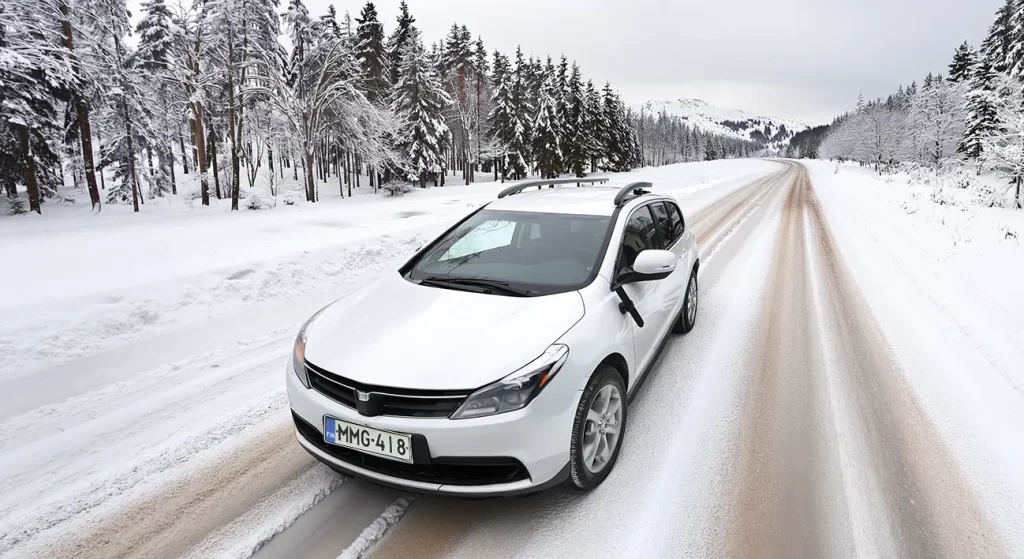
A mobile sensor installed on a maintenance vehicle reports conditions along the entire length of the route as the vehicle travels. Every point on the road the vehicle passes becomes a data point. When multiple vehicles collect data simultaneously, the state of the entire road network updates on the map in real time and without blind spots. Achieving equivalent coverage would require a far greater number of fixed stations.
Data where maintenance decisions are made
A mobile sensor on a salt truck or plough gives the driver and the area supervisor real-time information about what is actually happening on the road surface — right now, on the section of road the vehicle is travelling. This is not recalled from a previous patrol — it is data transmitted live from the current route.
Teconer's RCM50 System
Small, versatile, and easy to install
The Teconer RCM50 (watch the video) series sensors are compact optical units designed for straightforward installation on any vehicle, from a passenger car to a heavy plough truck. The small physical size makes installation practical even on vehicles without dedicated mounting provisions. The sensor can be transferred easily between vehicles as operational needs change.
What the RCM511 measures
The RCM511 sensor reports surface condition (dry, wet, icy, snowy), coefficient of friction, water layer thickness, and ice layer thickness. All data is processed in the sensor’s microprocessor and transmitted in real time to the roadweather.online map and to maintenance management systems via standard interfaces.
The µTEC friction meter
Data as the Basis for Decision-Making
For lighter-duty friction measurement applications, Teconer’s µTEC is an Android smartphone application that measures friction coefficient by analysing vehicle deceleration during controlled braking events where the tyres begin to slip. The µTEC has been certified for quality control use by the Finnish Transport Infrastructure Agency, making it suitable for regular patrol-based friction surveys.
The value of mobile road condition monitoring lies in the decision the data makes possible. When a maintenance vehicle reports a friction coefficient below the threshold for safe driving on a section of road, the area supervisor can redirect additional resources to that section immediately. When all maintenance vehicle sensors report safe conditions, resources can be reallocated elsewhere or kept on standby.
Teconer’s roadweather.online platform aggregates data from both fixed road weather stations and mobile RCM sensors into a single map view, giving operations centres a complete picture. The system supports both real-time monitoring and historical data analysis — a useful tool for post-event review, maintenance planning, and contractor performance assessment.