

The Moisture Problem in Concrete Production
Concrete strength is largely determined by the water-to-cement ratio in the mixing process. Too much water weakens the final product; too little reduces workability and disrupts the cement’s chemical hardening reaction (hydration), meaning the concrete never reaches its full strength.
The core problem is that aggregate — sand, gravel, crushed stone — arrives at the concrete plant with variable moisture content. A batch of sand that has been rained on overnight contains significantly more water than the same sand after two dry days. If this variability is not measured and compensated for in batching, the water-cement ratio drifts, and concrete quality varies from batch to batch.
In structural concrete — used in load-bearing structures such as foundations, columns, and floor slabs — this variability is not acceptable. Standards for reinforced concrete (concrete with embedded steel reinforcement) specify tight tolerances on water-cement ratio. Meeting those tolerances reliably requires knowing the moisture content of each aggregate batch before it enters the mixer.
The Limitations of Manual Sampling
Sampling is slow and imprecise
The traditional method for measuring aggregate moisture involves taking a sample, drying it, and weighing it. The process takes time, so moisture content is measured infrequently. Batching is then adjusted based on historical averages or operator experience — not the actual current condition of the material.
Moisture is not uniform across a pile
Moisture does not distribute evenly through an aggregate pile. The surface may be drier than the interior; material that has been sitting in one place differs from material freshly tipped from a truck. A spot sample describes one point — not the full flow of material that actually enters the mixer.
How the Teconer WCM411 Solves the Problem
Continuous, non-contact measurement
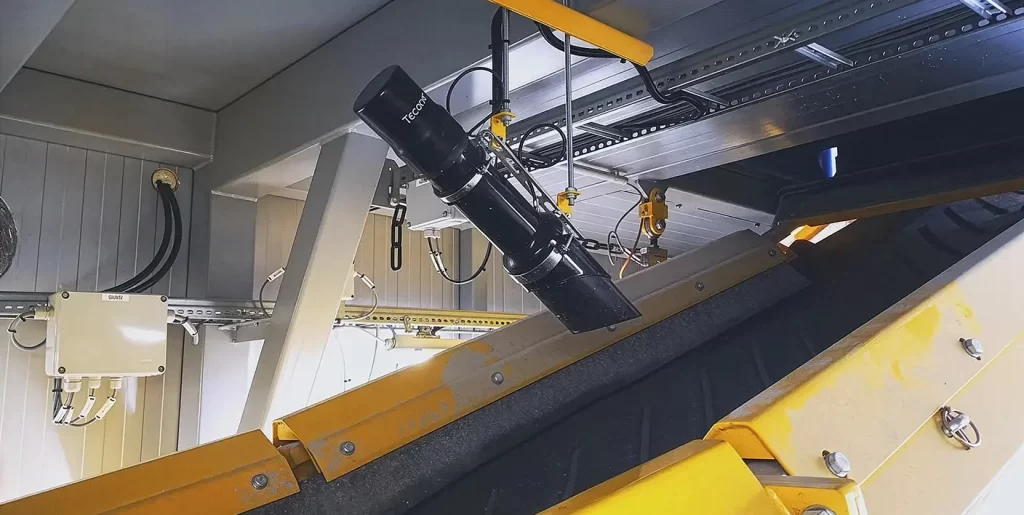
The Teconer WCM411 is an optical moisture sensor that measures the moisture content of aggregate continuously and without contact. Positioned above a conveyor belt or silo feeder, the sensor emits light toward the moving material and analyses the reflected signal. Moisture content is calculated as a percentage of water by weight of dry aggregate.
Because the measurement is continuous, the WCM411 (datasheet) captures the actual moisture of the material as it flows — not a snapshot from a sample taken at a different time or location. Every portion of material that passes under the sensor is measured.
Integration with batching automation
WCM411 (presentation) provides a 4–20 mA current loop output, the standard interface for industrial process control systems. This means the moisture reading can be fed directly into the plant’s batching system, which automatically adjusts the water addition to maintain the target water-cement ratio. The correction happens in real time, for every batch.
A serial RS232 interface supports monitoring and calibration through the included VipuNET software. The VipuNET software provides both a live data view and a calibration window for sensor configuration.
Non-invasive installation, minimal maintenance
The WCM411 is a remote-sensing device — it does not contact the material it measures. This eliminates wear from abrasive aggregates and means the sensor requires minimal maintenance beyond occasional lens cleaning. Its long service life and stable performance make it a cost-effective investment over a production plant’s multi-decade lifespan.
Beyond Concrete: Other Applications
Teconer’s optical moisture measurement technology is applicable wherever aggregate or bulk material moisture affects product quality or process efficiency: asphalt plants (where aggregate moisture affects mix temperature and quality), crushing and screening facilities, gravel pits, paper and cardboard mills, and continuous material flow monitoring in general processing applications.
The WCM411 moisture measurement tool is also well suited to production facilities in the paper and cardboard industry.