

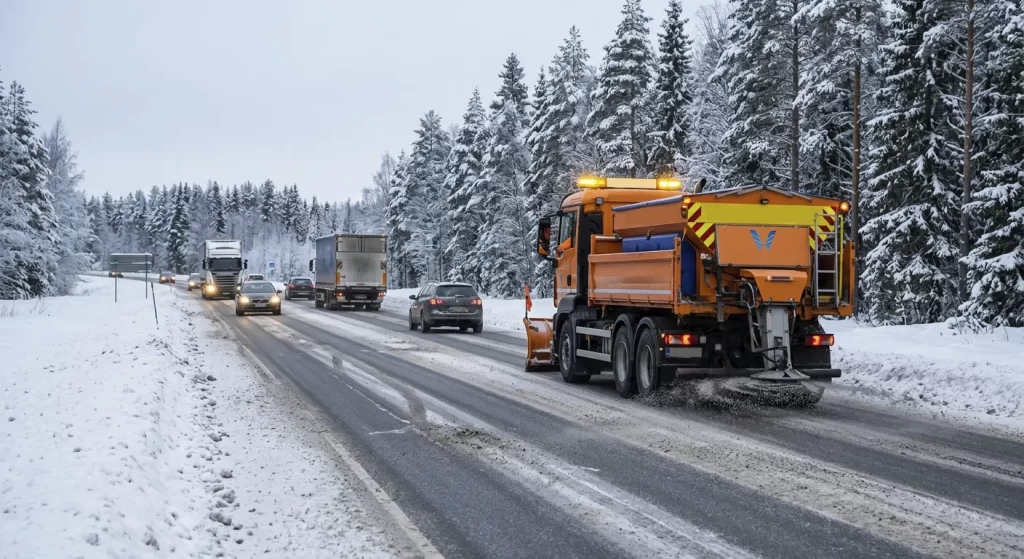
The Hidden Cost of Not Knowing
Without up-to-date information on the actual condition of the road surface, salting, sanding, and ploughing happen based on guesswork. Costs accumulate from unnecessarily frequent maintenance runs and preventive treatment — regardless of whether there is a real need.
The result is systematic overuse of resources on nights when weather conditions require no action at all — and too often, a slow response on those hours when conditions change suddenly between fixed patrol schedules.
What Fixed Schedules Actually Cost
Excess salting and material waste
Nordic studies have repeatedly shown that switching to data-driven anti-icing reduces salt consumption by 20–40% compared to schedule-based operations. Every kilogram of salt spread on a surface that didn’t need treatment is an unnecessary cost — and it also burdens roadside environments, surface waters, and road structures.
Fuel and labour overhead
Maintenance vehicles operating on fixed schedules consume fuel and accumulate labour hours even on runs where no action is needed. When the wear from unnecessary vehicle use is also factored in, the costs over an entire winter season are significant.
The under-treatment failure
Fixed patrol intervals can leave an icing window uncovered: salting done at 2 AM may have lost its effectiveness by 4 AM in overnight frost, with the next scheduled run not until 6 AM. This window increases the risk of traffic accidents..
How Real-Time Data Changes the Equation
RWS11 provides continuous data
Teconer’s compact RWS11 road weather station automatically measures road surface condition, friction, water and ice layer thickness, air pressure, surface temperature, and dew point. The data is available in real time via the roadweather.online service and can be integrated into maintenance management systems.
When maintenance teams have access to this data, operations are timed according to actual conditions: vehicles don’t head out because the clock says so, but only when the surface temperature is approaching the dew point and icing is imminent.
Mobile sensors extend coverage to the full network
Fixed road weather stations cover specific points on the network. Teconer’s RCM50 series mobile road condition sensors extend real-time data to the entire route. An RCM sensor mounted on a maintenance vehicle reports surface condition, friction, and water and ice layer thickness as the vehicle travels — data is sent in real time to the roadweather.online map, where the person responsible for maintenance can monitor the whole road network at a glance.
The Business Case for RWIS Investment
The combination of fixed RWS stations and mobile RCM sensors forms a Road Weather Information System (RWIS) whose data benefits translate into concrete savings: reduced salt consumption, fewer unnecessary runs, better allocation of maintenance equipment, and improved road safety. Based on experience, the payback period for larger road networks is typically one winter season.
Data accuracy also helps with accountability. Documented, timestamped measurement data demonstrates that operational decisions were made on the basis of reliable information — an increasingly important proof point for both authorities and contract clients.